



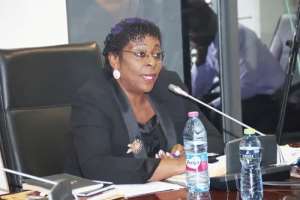
Supreme Court nominee Justice Sophia Rosetta Bernasko Essah has affirmed that the apex court has the constitutional authority to depart from its previous decisions when it considers such a step necessary.
Justice Bernasko Essah made the submission during her vetting before Parliament’s Appointments Committee on Thursday, August 27, 2026, in Accra.
Responding to a question from Majority Leader James Agalga on whether the Supreme Court should be permitted to overturn or depart from its earlier decisions, the nominee cited Article 129(3) of the 1992 Constitution.
She explained that although previous decisions of the Supreme Court are ordinarily binding, the Constitution expressly allows the Court to depart from an earlier ruling where it considers it appropriate to do so.
“The Supreme Court is required under Article 129(3) to depart from its decisions if need be,” she said.
Article 129(3) provides that: “the Supreme Court may, while treating its own previous decisions as normally binding, depart from a previous decision when it appears to it right to do so; and all other courts shall be bound to follow the decisions of the Supreme Court on questions of law.”
Justice Bernasko Essah further explained that the provision gives the Supreme Court room to reconsider its position where an earlier decision is found to be erroneous, inconsistent or capable of causing injustice.
She said the Court’s ability to revisit its previous decisions reflects the fact that judicial decisions, like other human endeavours, are not necessarily infallible.
According to her, where compelling circumstances arise or a reassessment of the law shows that an earlier position is no longer appropriate, the Supreme Court can exercise its constitutional discretion to depart from that decision.
Her position highlights the balance between maintaining consistency in the law and ensuring that justice is served.
While the doctrine of precedent promotes certainty and predictability by requiring courts to follow established legal principles, Article 129(3) gives the Supreme Court limited flexibility to correct decisions it considers wrong or unjust.

 Trump signs order to rename Lake Ontario to 'Lake America' as Carney pushes back
 Police restrict concrete mixer trucks on Accra, Tema roads from August 28
 Supreme Court nominee Anthony Forson Jnr. opposes proposal to cap number of just...
 Justice Bernasko Essah explains why Supreme Court may depart from its previous d...
 Two NDC MPs whose ‘secret’ marriages have shocked Ghanaians
 All you need to know about Hon. Millicent Yeboah-Amankwa, wife of Hon. Mahama Ay...
 ‘A true trailblazer and cultural icon’ – Bawumia mourns Grace Nortey
 Vetting: 'Suspects should sue police if detained beyond 48 hours' - Supreme Cour...
 Speaker Bagbin outdoors uniforms for new parliamentary security guards
 Minority NPP boycotts vetting of three Supreme Court nominees over rushed timeta...

