



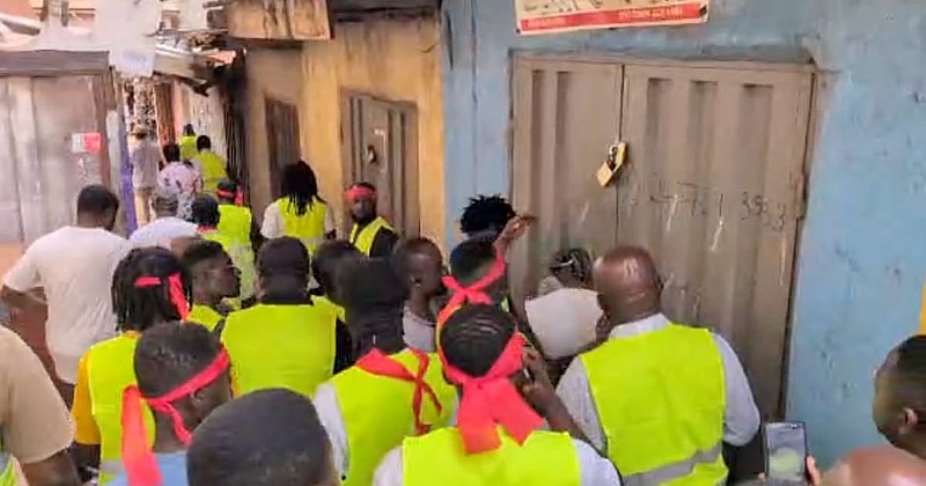
The reported decision by some Ghanaian artisans at Suame Magazine in Kumasi to forcibly close shops belonging to Nigerian spare-parts dealers is unacceptable and must be condemned.
Ghana has every right to regulate commercial activities and enforce its investment laws. However, such enforcement must be undertaken by authorised state institutions, not individuals or trade groups who choose to take the law into their own hands.
It is important to recognise that Ghana's investment laws place restrictions on certain categories of trading activities reserved for citizens. Section 32(1)(a) of the Ghana Investment Promotion Authority Act, 2026 (Act 1173), prohibits non-citizens and enterprises not wholly owned by Ghanaian citizens from engaging in activities such as selling goods in markets, petty trading, hawking and operating stalls. Section 31 also establishes conditions for foreign participation in trading enterprises.
These legal provisions, however, do not confer powers on local traders or associations to intimidate, assault or arbitrarily shut down businesses operated by other Africans. The authority to enforce the law belongs to the relevant state agencies. Where there are suspected breaches, the appropriate institutions must investigate and take action in accordance with established legal procedures.
More importantly, the developments at Suame Magazine raise serious questions about the willingness of some local traders to embrace competition.
There have been complaints from consumers about the high prices charged by some Ghanaian spare-parts dealers, while Nigerian traders are often perceived to offer more affordable alternatives. Rather than examining their pricing structures and improving the quality of their services to attract customers, some local operators appear to be seeking to drive competitors out of the market.
This attitude does little to promote a healthy business environment. In the absence of a comprehensive price-control system covering every spare part, competition plays an important role in protecting consumers from excessive charges.
No trader should assume that market dominance gives them the right to dictate prices or deny consumers the opportunity to purchase goods from alternative suppliers. It is particularly unfair for businesses to charge high prices and then attempt to eliminate competitors whose products are available at lower costs.
Claims that foreign dealers are undercutting local businesses must also be subjected to objective scrutiny. Where a Nigerian trader offers genuine spare parts at a more competitive price, consumers should not be intimidated or punished for making that choice.
Local traders must understand that the survival and growth of their businesses depend on their ability to adapt to changing market conditions. They should explore better supply arrangements, improve operational efficiency and adopt reasonable pricing strategies. Competition should encourage innovation and better service delivery, not provoke hostility and intimidation.
The matter also has broader implications for Ghana's relationship with other West African countries. Ghana and Nigeria are both members of the Economic Community of West African States (ECOWAS), an organisation established to promote regional cooperation, economic integration and the movement of people and goods across the sub-region.
While membership of ECOWAS does not exempt foreign businesses from complying with the laws of their host countries, it should encourage mutual respect and cooperation among citizens of member states. Regional integration cannot thrive in an atmosphere where people from neighbouring countries are treated as enemies simply because they operate competing businesses.
Ghana cannot consistently advocate economic integration and regional cooperation while tolerating the mistreatment of fellow West Africans within its borders. Equally, we cannot demand that Ghanaian traders receive fair treatment in other ECOWAS countries while remaining silent when Nigerian traders face intimidation and humiliation in Ghana.
The actions of those who resort to force instead of following lawful procedures reflect an unfortunate attitude towards competition and economic freedom. Seeking protection from competitors while refusing to offer consumers fair prices is not a sustainable way to build local businesses.
Such conduct does not advance the interests of Ghanaian traders. Rather, it damages the country's reputation as an investment destination and undermines the broader objective of promoting African economic cooperation.
The government must therefore take a firm but balanced approach. The relevant authorities should establish which businesses are operating in violation of Ghana's investment laws, distinguish between wholesale and prohibited retail activities, and ensure that any enforcement action is carried out through the appropriate legal channels.
Ghanaian businesses deserve protection under the law, but consumers equally deserve access to fair prices and competitive markets. Foreign traders operating in the country must comply with Ghanaian laws, but they must also be protected from intimidation, harassment and mob justice.
The Suame Magazine incident should serve as a reminder that the rule of law must prevail over economic selfishness and hostility towards competitors.
As members of ECOWAS, Ghana and Nigeria have a shared responsibility to promote peaceful commercial relations. Our markets must be governed by fairness, lawful competition and mutual respect, not intimidation, greed or hostility towards our neighbours.

 Illegal chainsaw operators damage GRIDCo transmission line, disrupt power supply...
 13 remanded for posing as NAIMOS officers to extort money from miners
 Agbodza accuses contractors of deliberately abandoning Year of Roads projects to...
 ICU-Ghana petitions Mahama to withdraw NPA Bill over concerns about BOST's futur...
 Suame Magazine shop closures: Ghana must uphold the law, not encourage hostility...
 COCOBOD recalls Natural Asontem fertiliser over expiry date, labelling concerns
 Ghana records 94 % reduction in child labour cases in 2024 but... — Report
 Ocloo urges communities to contribute GH¢80 to replace faulty streetlight photoc...
 You have no money to recruit teachers and nurses but you have money to buy presi...
 I took only 59 birds to protest NDC bias in Nkoko Nkitinkiti distribution but i ...


