




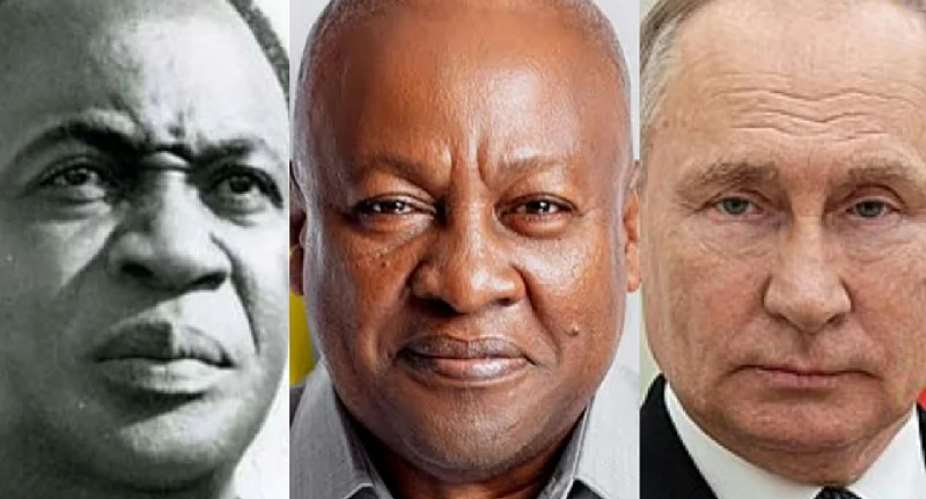
The emergence of a multipolar world order, as President Vladimir Putin has emphasised in his engagements with African leaders, presents Africa with another historic opportunity to redefine its position within the international political and economic system. More than six decades after political independence, a worrying prediction by Ghana’s first President, Kwame Nkrumah, has proved prescient: the continent continues to confront one of the most enduring contradictions of its postcolonial existence, political sovereignty without the corresponding economic power to determine the conditions of its own development.
The gradual erosion of Western dominance and the emergence of competing centres of global power, particularly China, Russia, India and other emerging economies, have created new opportunities for African countries to diversify their diplomatic and economic relationships. However, alternative global powers will not necessarily guarantee a more equitable international order. Nor does the intensifying competition for African resources, markets and strategic influence automatically translate into greater economic independence.
The fundamental question, therefore, is not merely whether Africa stands to benefit from a multipolar world, but whether African governments possess the political will, institutional capacity and collective economic strength to transform these changing geopolitical dynamics into an instrument of African power.
It is within this broader historical and ideological context that President John Dramani Mahama’s Accra Reset initiative assumes particular significance.
Launched at the United Nations General Assembly in September 2025, the Accra Reset seeks to reconsider the architecture of international development cooperation and the unequal relationships that have historically characterised interactions between developed and developing countries. Its central proposition is that the prevailing development model, characterised by excessive dependence on external assistance, fragmented institutional arrangements, and financing structures that frequently respond to donor priorities, has failed to sufficiently strengthen the development capacities of countries in the Global South.
The initiative consequently advocates a transition towards country-led development systems, stronger domestic institutions, coordinated financing arrangements and international partnerships that contribute to productive economic transformation.
The Accra Reset emerged particularly from the recognition of Africa’s vulnerability within the international health system. The continent’s dependence on external financing, imported pharmaceuticals, vaccines and medical technologies has exposed the limitations of political independence where essential public services remain subject to decisions taken beyond national borders. Accordingly, the initiative proposes reforms in global health financing and governance, greater investment in local pharmaceutical manufacturing and scientific innovation, and stronger national health institutions.
Its proposed mechanisms, including the High-Level Panel on Global Health Architecture and Governance Reform and the Health Investment National Gateway, seek to translate international commitments into country-led investments. Beyond health, the initiative articulates broader ambitions for development financing, regional industrialisation, technological cooperation and more equitable international economic partnerships. Its proposed Sovereign Prosperity Spheres envisage stronger coordination of productive investment, infrastructure and financing across neighbouring economies.
These proposals remain subject to implementation, but they suggest a departure from a development philosophy that measures international cooperation primarily by the volume of external assistance received, towards one that prioritises domestic productive capacity and institutional autonomy.
In many respects, the philosophical thrust of this initiative evokes the unfinished political and economic project of Kwame Nkrumah, whose conception of African independence extended beyond territorial sovereignty to include economic self-determination, industrial development and continental political unity.
For Nkrumah, political independence without economic autonomy represented an incomplete liberation from colonial domination. His critique of neocolonialism recognised that foreign control could persist through international financial institutions, commodity markets, investment arrangements and unequal economic relationships long after formal colonial administration had disappeared.
Sixty years after his overthrow, the relevance of this argument remains difficult to dismiss.
Africa continues to supply substantial quantities of raw materials to the global economy while importing manufactured goods and technologies derived, in many instances, from its own natural resources. This structural imbalance has sustained the continent’s vulnerability to external commodity price fluctuations, foreign financing conditions and international economic decisions over which it exercises limited influence.
Within this frame, Mahama’s Accra Reset may be understood as a contemporary attempt to revisit the unresolved contradictions in Africa’s post-independence development trajectory. However, an important distinction must be maintained. The Accra Reset is a specific international development and institutional reform initiative, rather than the entirety of Mahama’s domestic Reset Agenda or a comprehensive foreign-policy doctrine. Nevertheless, these orientations may be understood within a broader political philosophy that places strategic autonomy and economic transformation at the centre of Ghana’s contemporary development aspirations.
President Mahama’s engagement with Russia, for instance, must be situated within changing international-relations dynamics rather than interpreted as an institutional component of the Accra Reset.
Russia’s renewed diplomatic and economic interest in Africa reflects the changing global order, particularly as established Western powers confront growing competition from alternative centres of international influence. For African countries, these developments present opportunities to expand cooperation in infrastructure, energy, agriculture, technology and development financing.
However, the emergence of alternative partners should not be mistaken for the automatic dismantling of neocolonial economic structures.
The critical question is whether these relationships will fundamentally alter Africa’s position within the international division of labour or merely reproduce the same unequal arrangements under different geopolitical alliances.
If Africa continues to export unprocessed natural resources, depend on foreign technologies and surrender substantial portions of its economic value to external interests, then the transition from Western dominance to multipolar competition may change the identity of its development partners without transforming the underlying conditions of dependency.
This distinction is particularly important in understanding the relevance of Nkrumah’s doctrine of non-alignment to contemporary African foreign policy. His conception of non-alignment was not simply neutrality between competing Cold War powers, but an assertion of the sovereign right of newly independent states to pursue development policies without becoming subordinate to external ideological or strategic agendas.
For Mahama’s administration, engagement with Russia, China, the United States, Europe, India and other international partners need not imply ideological commitment to any particular geopolitical bloc. His emphasis on pragmatism in discussing Ghana’s international relationships is consistent with a foreign-policy orientation grounded in cooperation without subordination, partnership without policy capture and international engagement without surrendering national development priorities.
Thus, the value of these relationships must be assessed against their contribution to industrial capacity, technological development, productive employment, skills transfer and the retention of greater economic value within African economies.
The challenge is not merely to diversify Africa’s international relationships, but to transform their economic character.
This is where the broader philosophy underlying the Accra Reset becomes relevant to Africa’s engagement with the multipolar world. Its emphasis on country-led development, institutional autonomy and equitable international cooperation provides a framework through which African governments may reconsider the developmental value of their external partnerships.
The question of African economic transformation, however, cannot be separated from the historical struggle for continental integration. One enduring contradiction of Africa’s postcolonial development has been the persistence of fragmented national economies operating within an international economic system dominated by larger and more industrialised states.
It was precisely this contradiction that informed Nkrumah’s insistence that African unity was not merely a political aspiration but an economic necessity.
Within this historical context, the African Continental Free Trade Area (AfCFTA) represents one of the most significant contemporary opportunities to advance the unfinished project of African economic integration. Although AfCFTA is an independent African Union framework rather than an institutional creation of the Accra Reset, its objectives complement the initiative’s broader aspirations for regional industrialisation and productive investment.
By establishing a larger integrated market, the AfCFTA creates opportunities to expand intra-African trade, develop regional industrial value chains and strengthen African enterprises. However, trade liberalisation without corresponding industrial development may simply increase the circulation of imported goods across African markets without increasing African productive capacity.
The challenge, therefore, extends beyond trade liberalisation to the deliberate construction of an African industrial economy through coordinated industrial policies, regional infrastructure, stronger financial institutions and technological development.
While the AfCFTA provides the institutional framework for continental market integration, the Accra Reset seeks to reconsider aspects of international financing and development cooperation that could support regional economic transformation. Its proposed Sovereign Prosperity Spheres are particularly relevant, as they recognise the importance of coordinating investment and production across national boundaries.
Together, these initiatives offer possibilities for advancing a development model in which African resources, markets and institutions become increasingly central to the continent’s economic transformation.
Yet, the emergence of a multipolar world raises an even more fundamental question about the character of African power.
Can Africa become an influential geopolitical actor without developing the economic and institutional capabilities necessary to exercise collective power?
For decades, Africa’s participation in global affairs has frequently been defined by its strategic importance to external powers rather than its capacity to determine the rules governing those relationships. Despite its considerable resource endowment and significant position in global commodity supply chains, energy markets and critical mineral production, the continent has exercised limited influence over the international financial and technological systems that shape its development.
The concept of African hegemony becomes relevant here, not as an ambition to dominate other regions, but as an expression of Africa’s capacity to exert meaningful influence over international institutions, markets and economic decisions.
Such influence cannot be secured merely through diplomatic visibility, international summits or declarations of continental solidarity. It must be constructed through industrial production, technological innovation, domestic resource mobilisation and coordinated continental economic policies.
When African countries compete for foreign investment through excessive concessions and preferential resource agreements, they risk weakening their collective bargaining power. Similarly, when governments negotiate separately over strategic minerals, infrastructure financing and market access, external partners may benefit from the fragmentation of African interests.
Continental coordination must therefore be understood not simply as an expression of Pan-African solidarity, but as an instrument of economic and geopolitical power.
The Accra Reset must therefore confront the institutional weaknesses that have historically constrained Africa’s capacity to translate political aspirations into development outcomes. The continent has articulated ambitious objectives through Agenda 2063, the AfCFTA and other regional frameworks, yet the gap between policy commitments and implementation remains substantial.
The problem is not necessarily the absence of development visions, but the failure to consistently align political leadership, institutional capacity, financing and implementation with common priorities.
This is why the Accra Reset’s specific policy mechanisms deserve critical attention. Its proposals for reforming global health governance, strengthening national financing systems and improving institutional coordination must ultimately be judged by measurable improvements in institutional performance, domestic resource mobilisation and productive capacity.
Infrastructure financing should strengthen regional transport networks, energy systems and industrial development. Cooperation in critical minerals should prioritise domestic processing, technological advancement and manufacturing. Agricultural partnerships must improve food security and agro-processing, while technological cooperation should strengthen African research institutions and innovation.
Development cannot be reduced to the availability of external financing or foreign investment. It becomes transformative when it expands societies' capacity to produce, innovate, create employment and exercise greater control over their economic lives.
The contemporary struggle for African economic transformation must therefore be understood within the longer historical trajectory of the continent's political liberation.
Nkrumah understood that political independence would remain vulnerable without continental unity and economic self-determination. His overthrow in 1966 marked a decisive interruption of Ghana’s early post-independence developmental experiment and the broader Pan-African ambition to construct an autonomous continental political and economic order.
Sixty years later, the fundamental questions that shaped that historical moment remain unresolved. Who controls Africa’s natural resources? Who determines the conditions of its international economic relationships? And who captures the value generated from its production?
These questions have acquired renewed significance as the global order becomes increasingly multipolar.
For President Mahama, the Accra Reset offers an opportunity to articulate a contemporary expression of the Nkrumahist concern for economic self-determination within a democratic and increasingly interconnected international order. Its significance, however, will depend less on the ideological appeal of its aspirations than on its capacity to translate proposed reforms into measurable development outcomes.
If the struggle for political independence defined Africa’s liberation movements of the twentieth century, the struggle for economic transformation must define the character of its development in the twenty-first.
The ultimate test of Mahama’s Accra Reset, therefore, is not whether Africa succeeds in replacing one set of powerful international partners with another, but whether it can transform the economic conditions under which those partnerships are negotiated. The unfinished project of African independence will only be realised when the continent moves beyond the freedom to choose its development partners to the power to determine the terms and outcomes of its own development.

 Ghana introduces 21-day monitoring for travellers from Ebola-affected countries
 Let’s stop bashing NACOC anytime there is drug bust – Hopeson Adorye
 Sam George threatens to shut down political, religious affiliated media houses i...
 'We are demanding our GH¢16m back' – Abu Jinapor at 'Yɛ Gye Yɛ Sika' demo
 'Don't defend accountability only in opposition' – Osahen Afenyo-Markin tells Af...
 Mother of slain Ghanaian teenager heads to US for son's funeral
 'People want to directly elect their MMDCEs' — CDD-Ghana rejects govt proposal
 Parliament’s Human Rights Committee calls for reintroduction of safe disciplinar...
 Chief Justice orders Supreme Court to sit despite ongoing JUSAG strike
 Free SHS food suppliers threaten five-day protest over unpaid debts


