




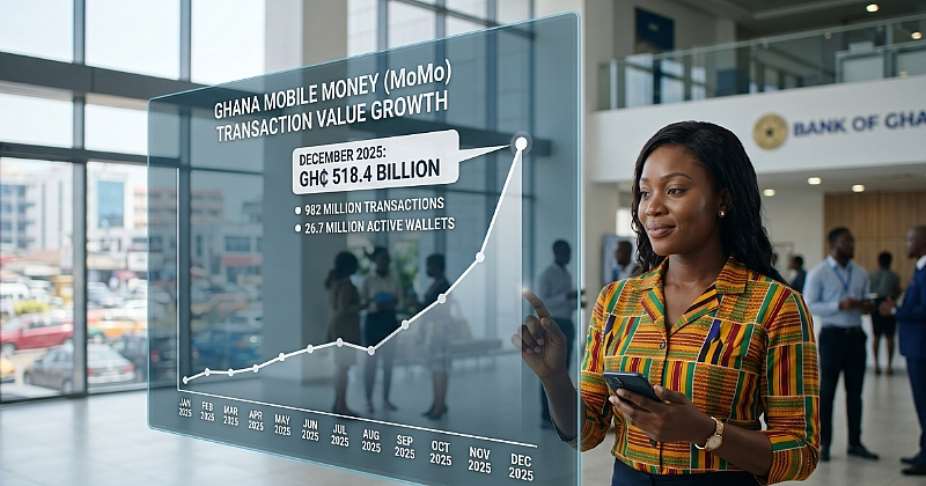
Every mobile money transfer, every ride-hail booking, every social media scroll creates a digital record. As Ghana's digital economy accelerates, personal data is becoming an increasingly valuable economic resource. But the same data that enables faster transactions and personalised services is also creating new risks around privacy, misuse and fraud.
The scale of Ghana's digital activity is already significant. Active mobile internet subscriptions reached 29.7 million in early 2026, anchoring a strong national digital penetration rate of 87.7 per cent. In parallel, digital transaction values across mobile banking, internet banking and instant interbank settlement systems have maintained aggressive, multi-digit compound year-on-year growth.
Every digital transaction leaves information behind. A phone number, when connected to a person's identity, financial activity, location or online behaviour, can become part of a much larger personal profile. In an economy rapidly moving from cash to digital, such information is becoming an increasingly important economic resource.
The Legal Framework: What the Data Protection Act Provides
Ghana has had a legal framework for addressing these questions since the Data Protection Act, 2012 (Act 843), came into force in October 2012. The law governs the collection, use, disclosure, destruction and care of personal data and requires data controllers to register before processing personal information .
The law gives individuals important rights. A data subject has the right to know how their information is being processed, the purpose of the processing and the recipients or categories of recipients to whom it may be disclosed. Individuals can also object to certain processing and request access to their personal information. Where data is inaccurate, irrelevant, excessive, out of date, incomplete or misleading, a data subject may request correction or deletion .
The Act also requires organisations to take security measures and provides for notification to the Commission and affected individuals where there are reasonable grounds to believe personal data has been accessed or acquired without authorisation.
For businesses, responsibly processed data can improve services, detect fraud, understand customers and develop products. For consumers, the benefits can include faster transactions, personalised services and greater access to digital finance. Ghana's growing digital economy depends on the legitimate use of information.
The Enforcement Push: 2026 as the Year of Action
The Data Protection Commission has declared 2026 the "Year of Enforcement". Dr Arnold Kavaarpuo, Executive Director of the Commission, has stated that compliance with the Data Protection Act is "non-negotiable for any organisation that handles the data of Ghanaian citizens" .
The Commission has received two new pickup vehicles to strengthen enforcement and expand its field operations, procured with internally generated funds . It is taking steps to establish offices in the Eastern, Ashanti, Northern, Western and Bono regions by the end of the year . The Commission also continues to receive complaints involving unauthorised digital loans, improper disclosure of health records and unlawful reuse of personal information .
The government is also pushing for stronger data governance. The Communications Minister has announced that Ghana is progressing with a Data Harmonisation Bill, designed to support interoperability, secure datasets and improve the management of data access protocols . There are also plans to upgrade the Data Protection Commission into a full-fledged authority with enhanced regulatory powers.
The Risks: When Data Outpaces Safeguards
A data breach can expose personal information to criminals. Unauthorised sharing can undermine privacy. Poor data management can create opportunities for fraud, identity theft and unwanted marketing.
The Supreme Court recently ruled against Vodafone Ghana, finding that the company breached a customer's data privacy by allowing an unknown individual to register and operate a mobile money wallet using his Ghana Card details without his consent . The court awarded GH¢10,000 in nominal damages, citing the potential for identity misuse and money laundering risks. Justice Yonny Kulendi stated that the company's failure to implement basic verification measures "constituted a clear dereliction of the Respondent's statutory obligations" and "amounted to an invasion of his privacy under Article 18 of the Constitution" .
The ruling draws on Ghana's Data Protection Act and landmark privacy cases, including Mrs Abena Pokuaa Ackah v. Agricultural Development Bank and Raphael Cubagee v. Michael Yeboah Asare . It underscores the risks of identity misuse and unauthorised access.
The Second Deputy Speaker of Parliament, Andrews Asiamah Amoako, has also called for stronger national control over identity, data and digital systems, warning that sovereignty in the digital century now extends beyond territorial boundaries. He stressed that identity determines how citizens and countries are remembered and that the defining question is whether Ghana will take control of digital transformation or merely experience its impact
ASJ Way Forward
Ghana is building a digital economy in which information increasingly moves alongside money. The challenge now is to ensure that as the country creates wealth from digitalisation, it does not leave citizens paying the hidden price with their privacy.
Consumers need clearer privacy notices, stronger digital literacy and greater awareness of their rights. Businesses need to collect only information necessary for legitimate purposes, strengthen cybersecurity and make consent meaningful. Regulators must continue enforcement, improve public education and ensure that breaches and unlawful processing attract consequences.
As the Communications Minister noted, Ghana's investments in digital identity systems, mobile money and e-government services depend on public confidence in how personal data is handled . The phone number may belong to an individual. The economic value created around that number, however, is becoming part of a much bigger national conversation about power, privacy, trust and who ultimately benefits from Ghana's data.

 Ayitey Powers arrested over alleged death threat against Yaw Ampofo Ankrah
 It lies with Sammy Gyamfi to prove his extortion allegation against Afenyo-Marki...
 ‘I’m ready to submit myself for investigation into Sammy Gyamfi extortion allega...
 Osahen Afenyo-Markin sues Sammy Gyamfi, others over extortion allegation
 CID yet to submit report on alleged assassination attempts on Kissi Agyebeng – M...
 NDC’s ‘love’ will soon end as Ghanaians demand results — Bryan Acheampong
 Court adjourns Tuba murder case to September 28 as Police prepare to forward doc...
 Mother seeks justice after four daughters allegedly abused by father at Gomoa Do...
 Muntaka reveals how prime suspect in 2024 Tolon election violence wins NPP const...
 'I have not landed GoldBod contract to provide platform for buying and selling g...

