




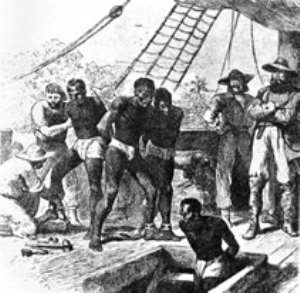
Very often, the embalmers of Western history have tried to gloss over the sordid trade in African slaves by Europeans, for over four century, by putting up the argument that lot of Africans also made a fortune in the dealings. From these 'mythorians' we often hear the stories that slavery was rampant in Africa long before the Europeans came along. Not only is slavery been argued away, the colonial oppression of Africa is also been massaged to make it appear less cruel. We are told that the colonies also enjoyed the fruits of colonization. Christianity and Western-styled education are often cited as the 'benefits' Africans derived from colonialism. These apologists then asked why must it be that all the opprobriums are directed against Europeans alone?
Even more unfortunate is the fact that some Africans, especially those in the diaspora, have bought into these pseudo-arguments.
In this essay I shall try to put slavery in proper historical perspectives, and show how the chattel slavery introduced by capitalism differs from all other forms of slavery.
To those who said Africans benefitted from slavery and colonialism, one can argue, with the same [twisted] logic, that the countries conquered by Nazis also enjoyed the fruits of Nazism. We can say that Holland, which was conquered and oppressed by German Nazis, also benefitted from their forced oppression. We can argue that the French, the Belgian, and the Dutch people who were forced into labor camps also benefitted! This manner of thinking is, of course, simply outrageous.
As any student of history knows, it was not only in Africa that slavery was rampant in ancient times. The Hebrew, Greek, Roman history tells of slavery. Watching slaves butchered each other was a sport enjoyed by the decadent rulers of the Roman Empire. The institution of slavery got mentioned several times in the Christian Bible: 'Moreover of the children of the strangers that do sojourn among you, of them shall ye buy, and of their that are with you, which they begat in your land: and they shall be your possession.' (Leviticus, 25, 44-46). 'If thou buy an Hebrew servant, six years he shall serve: and in the seventh year he shall go out free for nothing. If he came in by himself, he shall go out by himself: if he were married, then his wife shall go out with him. If his master have given him a wife, and she have born him sons or daughters; the wife and her children shall be her master's, and he shall go out by himself. And if the servant shall plainly say, I love my master, my wife, and my children; I will not go out free: Then his master shall bring him unto the judges; he shall also bring him to the door, or unto the door post; and his master shall bore his ear through with an aul; and he shall serve him for ever.' (Exodus XXI, 2-6). These are just two of the examples of the Hebrew god's opinion of slavery. The quotations are from the Christian bible.
The Jews, like many other people, have been enslaved several times. But does the fact that they have been oppressed several times in the past lessen the enormity of the Nazi Holocaust? We should be careful.
In middle-age Europe almost everyone was a serf. And it is often conveniently forgotten, by Western mythorians, that two out of every three Europeans that migrated to the New World was a serf - until Africans were introduced as slaves.
The Atlantic slave-trade was different from all these earlier slavery in several respects. Most enormously important is that it was the first form of slavery that was solely motivated by commercial incentives. In earlier times slaves were used as domestic workers and soldiers, since there were no plantations or industrial factories where millions of slave-labor was needed. The African slave-trade was a capitalist invention. Readers are directed to 'Slavery and Capitalism' by Eric Williams.
It was the large-scale capitalist mode of production which required cheap labors that induced the slave trade. It was the Industrial Revolution in Europe that made it necessary to traffic in human lives on a colossal scale.
Slaves in earlier times enjoyed social and individual rights - like marriage, freedom to raise a family, speak their language and worship their gods, rights which were denied the African slaves exported to the Americas. Africans captured and taken into the new world were stripped of all their personality and humanity. They could neither bear their own names nor speak their native languages.
It was capitalism that introduced chattel-slavery. In the welter of philosophical arguments for and against the slave trade, the one cogent and inescapable argument in favor of it is easily hidden: in spite of its risks, illegality, and blighted social status, slave trading was enormously profitable. Despite the popular assertion that free labor was cheaper, the price of slaves continued to go up and to compensate for the risks of the trade. - The Slaver's Log Book', original manuscript by Captain Theophilus Conneau, Prentice-Hall, Inc., 1976, p. iv.
In older times, slaves were not regarded as properties of their masters; manumission was possible and occurred frequently. Since slaves in those days were generally captured soldiers, they're treated humanely, because the possibility always existed that a military or spiritual giant could arise from their tribe and turn the tide in their favor. Moses was such a figure. We read about the account of his leading the Hebrews out of Egypt in the Christian Bible. These are some of the qualitative differences, between the Atlantic slavery and earlier forms of slavery. They are important differences which the European ideologists, masquerading as scientists and historians, want to gloss over.
Slaves became profitable after the discovery of the New World had established a seemingly insatiable demand for workers on the plantations. Slavery was not new to Africa, but it had existed primarily in its domestic form-involving rights as well as duties. In Bornu the kings sent slaves to govern their provinces and Hausa kings also often ruled through slaves. In Yorubaland, slaves of the ALAFIN often attain great power. It was the Europeans who turned slavery into an industry and introduced such well- documented barbarities as the rigors of the 'middle passage' (across the Atlantic). Walter Schwarz, 'Nigeria', Pall Mall Press. p.69).
People have asked why Africans themselves engaged in the slave trade. Given the function of slavery in African societies, the origin of their participation is not too difficult to understand.
First and foremost, slavery was not confused with the notion of superiority and inferiority, a notion later invoked as justification for black slavery in America. On the contrary, it was not at all uncommon for African owners to adopt slave children or to marry slave women, who then became full members of the family. Slaves of talent accumulated property and in some instances reached the status of kings; Jaja of Opobo (in Nigeria) is a case in point. Lacking contact with American slavery, African traders could be expected to assume that the lives of slaves overseas would be just as they were in Africa; they had no way of knowing that whites in America associated dark colors with sub-human qualities and status, or that they would treat slaves as chattels generation after generation. When Nigeria's Madame Tinubu, herself a slave-trader, discovered the difference between domestic and non-African slavery, she became an abolitionist, actively rejecting what she saw as the corruption of African slavery by the unjust and inhumane habits of its foreign practitioners and by the motivation to make war for profit on the sale of captives.
What these imperialist mythorians are striving to achieve is a situation whereby Black people will continue to blame themselves for all the enormous crimes visited on them by the white people. While African chiefs who got corrupted and sold their folks are bandied about with glee, no mention is made of many great African Kings and Queens who died fighting the slave-raids. Mani-Congo, the ruler of a Congo state wrote king John III of Portugal entreating that, “... we need from your kingdom no other than priests and people to teach in schools, and no other goods but wine and flour for the holy sacrament: that is why we beg of Your Highness to help and assist us in this matter, commanding the factors that they should send here neither mercenaries nor wares, because it is our will that in these kingdoms, there should not be any trade in slaves or markets for slaves.”
Slavery in Africa was punishment; as even a barbarian like Conneau recognized, “... it was meted out to violators of serious tabus, to criminals, and especially to enemies captured in war. Muslims in particular used slavery in lieu of death sentence. Bondage instead of death was the punishment for truly heinous offenses, as well as a solution to the problem of getting rid of one's captured enemies...” Conneau, op. cit. p.viii.
Language, they say, defines those that use it. The fact that slavery in Africa does not have all the negative connotations and brutalities associated with the chattel slavery could be seen from the Yorubas who have the same word 'ERU' for both slaves and prisoners of war. To them both are unfortunate victims of wars.
They are kept to serve terms and there are strict rules on how they should be treated. They are never engaged in plantations (there were none) with their mouths padlocked, they are not chained like cattle in pens. We should not even talked about the amoral breeding of human beings like cattle or the incestuous rape the slavers carried on their own children – an abomination in its own right!
And whereas Africans who participated in slavery had been well- documented, those who fought tenaciously against it remain unsung. Let's contrast this with the interpretation given to Europeans slave-drivers. Every West African student know the name of William Wilberforce - the 'Great Abolitionist,' the role of Queen Victoria and other European Royalties and 'Noblemen' who built their wealth on African slaves remain relatively unknown. How many Americans, not to mention Africans, know that the 'Great Libertarian,' Thomas Jefferson, was a slave-owner, or that the 'great Emancipator,' Abe Lincoln himself once sold a slave for a bottle of molasses?
It is natural for the guilty to look for parallels, so as to diminish the enormity of his crime, so it is with the Europeans. They are busy collecting bogus historical and anthropological findings and presenting same as historical fact to lessen their culpability in the greatest crime ever committed against a people, in the history of the world. Their assault on history should not be allowed to go unanswered.
I do not write this to exonerate the African chiefs who sold slaves to the Europeans. The fact we all have to bear in mind is that the Europeans never launched a direct, frontal attack on Africa. In all the places they conquered, they first divided the people by looking for a Judas among them. With the promise of material benefits, such Judas' are always the instrument used to destroy their own societies. For those who would like to know more about this, I strongly recommend 'THE DESTRUCTION OF BLACK CIVILIZATION', by Chancellor Williams - published by Third World Press. We can still see this trend continuing today in Africa. In Angola they used Savimbi to destroy his fatherland until he outlived his usefulness.
We should excuse our fathers if they appeared to have been swindled by the Europeans. Many of us, especially the immigrants from Africa, are also victims of Euro-American propaganda. We were swayed by the images of a paradisiacal Europe where streets are paved with gold and every white man is a god. We believed the smiling missionaries who told us tales about European hearts being filled with brotherly love and compassion. How many of us would have believed that we are going to a society where human beings are only as important as their bank accounts? How many of us would have believed that in the European paradise, there are jobless, homeless, copeless and hopeless people? How many of us would have believed that Cecil Rhodes was not a philantropist but a pirate? How many of us would have believed that in Euro-America exist homophobes, parading the streets with lynching intentions? How many of us would have believed that Europeans, after all, are capable of lying?
I shall end this piece with the following quotation: “When someone removes the cataracts of whiteness from our eyes, and when we look with unclouded vision on the bloody shadows of the American past, we will recognize for the first time that the Afro-American, who was so often second in freedom, was also second in slavery.
Indeed, it will be revealed that the Afro-American was third in slavery. For he inherited his chains, in a manner of speaking, from the pioneer bondsmen, who were red and white.
The story of this succession, of how the red bondsmen and of how white men created a system of white servitude which lasted in America for more than two hundred years, the story of how this system was created and why, of how white men and white women and white children were brought and sold like cattle and transported across the seas in foul 'slave' ships, the story of how all this happened, of how the white planter reduced white people to temporary and lifetime servitude before stretching out his hands to Ethiopia, has never been told before in all its dimensions. As a matter of fact, the traditional embalmers of American experience seem to find servitude enormously embarrassing, and prefer to dwell at length on black bondage in America. But this maneuver distorts both black bondage and the American experience. ...In the first place, white bondage lasted for more than two centuries and involved a majority of the white immigrants to the American colonies. It has been estimated that at least two out of every three white colonists worked for a term of years in the fields or kitchens as semi-slaves. A second point of immense importance in this whole equation is the fact that white servitude was the historical foundation upon which the system of black slavery was conducted.
In other words, white servitude was the historic proving ground for the mechanisms of control and subordination used in Afro-American slavery. The plantation pass, the fugitive slave law, the use of the overseer and the house servant and the Uncle Tom, the forced separation of parents and children on the auction block and the sexual exploitation of servant women, the whipping post, the slave chains, the branding iron; all these mechanism were tried out and perfected first on white men and white women. Masters also developed a theory of internal white racism and used the traditional Sambo and minstrel stereotypes to characterize white servants who were said to be good natured and faithful but biologically inferior and subject to laziness, immorality, and crime. And all of this would seem to suggest that nothing substantial can be said about the mechanisms of black bondage in America except against the background and within the perspective of the system of white bondage in America.” - Lerone Bennet, quoted by John Henrik Clarke in Introduction to 'World's Great Men of Color', Collier Books.
By: Femi Akomolafe

 One dead, fire officer hospitalised after bee attack at Quarry Site in Sokode Gb...
 Israel and Iran step back from further strikes after renewed clashes
 Patients stranded as doctors, nurses refuse to see new patients over KATH CEO su...
 Avenor Rural Bank CEO’s house destroyed by fire
 Three arrested in Winneba for illegal mining near GWL water lines
 Two pupils of Alice Elite Academy laid to rest after fatal school bus crash
 Here are areas to be affected by ECG's planned maintenance on Tuesday
 Family of civil engineer killed in alleged military shooting demands justice
 SHS teacher allegedly beats female student over unpaid hostel fees
 Blow to EU defence cooperation as France, Germany abandon joint fighter jet prog...



Comments
Complete rubbish